

Carbon handprint is a tool developed for companies to communicate the positive climate impacts of their products and services. It can also serve as an organizational development tool. In cases where achieving a carbon handprint is not feasible with current operations, calculating a carbon footprint can help identify major emission sources, reduce emissions, and ultimately, generate a carbon handprint.
According to the methodology developed by VTT and LUT, a carbon handprint can be achieved through various means (Pajula et al., 2018):
- Utilizing raw materials with low carbon footprints.
- Employing energy sources with low carbon footprints.
- Extending the lifetime and enhancing the use-phase performance of products.
- Reducing material loss and waste.
- Increasing carbon sequestration and storage.
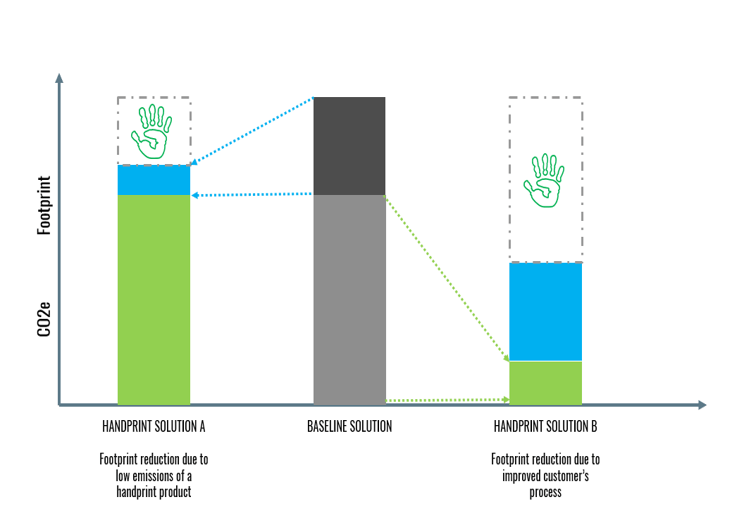
A carbon handprint can also occur if a product or service manages to reduce the carbon footprint of the end-user. This happens when a product or service has a smaller carbon footprint than the market baseline solution.
What is the use of calculating a carbon handprint?
- The tool serves as a growing and widely accepted means of communicating the positive climate impact of a product or service.
- It drives products and services towards being the best in the market from a climate perspective.
- The tool also helps companies and their products or services stand out in the market and reinforces a positive brand image.
- Continuous monitoring of the climate impacts and market trends ensures that any achieved leadership position is maintained.
Interested? Contact us, we would love to tell you more!
Sources:
- Pajula, T., Vatanen, S., Pihkola, H., Grönman, K., Kasurinen, H., & Soukka, R. (2018). Carbon Handprint Guide. VTT Technical Research Centre of Finland.