Using a carbon footprint calculator to reduce emissions
Through a carbon footprint calculator built on life cycle assessment (LCA) and Environmental Product Declaration (EPD) data, Framery is able to reduce the climate impacts of its products already at the design stage – while creating sustainable competitive advantage.
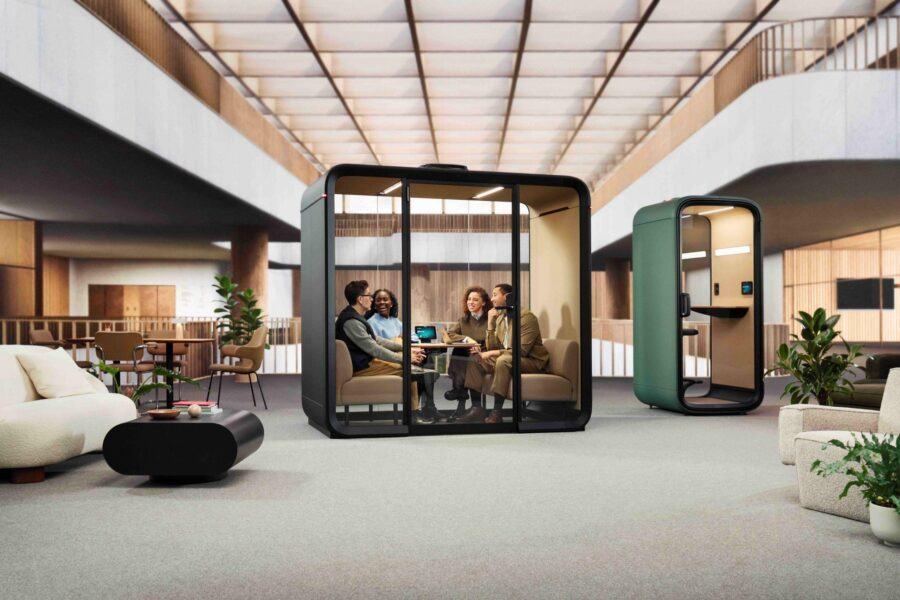
Situation
Framery is a rapidly growing global leader in the design and manufacturing of soundproof workspaces and smart office solutions. Increasingly, its customers demand more detailed product-level climate data as well as concrete emission reduction plans.
With annual revenue exceeding 200 million euros, Framery is a global player whose products are primarily assembled in Finland and exported to more than 90 countries. Its customer base includes major global corporations – 70 % of the companies on the Forbes Top 100 list use Framery’s products. In addition to quality, these customers expect a strong commitment to environmental responsibility from their suppliers.
Challenge
Framery began to systematically measure the climate impacts of its workspaces in 2024, following the launch of its new smart workspace product family. From the perspective of emission reduction, a key challenge emerged in the timing of existing documentation: assessments were produced only after the product had already been designed and launched to market. Framery realized that if it wanted to reduce its climate impacts quickly and effectively, these efforts would need to take place already at the design stage and in supplier selection.
This realization, however, introduced another challenge. The data derived from life cycle assessments and Environmental Product Declarations consisted of static reports lacking interactivity. During the design phase, Framery lacked a clear view of how different decisions would impact both product-level and organizational emissions.
Solution
Framery implemented a carbon footprint calculator based on life cycle assessment (LCA) and Environmental Product Declaration (EPD) data. The tool enables the company to assess the climate impacts of its workspaces already at the product development and design stage, before key decisions are locked in. It brings climate impacts directly into product design and procurement decision-making, allowing the effects of supplier and material choices to be evaluated immediately and adjustments to be made in time.
The solution goes beyond individual products: it also enables Framery to forecast the development of its organization-wide carbon footprint and steer operations toward its SBTi targets based on data-driven insights.
Next steps
Our collaboration does not end with a report — it continues as a partnership. We have supported Framery on an ongoing basis in both developing new life cycle assessments and updating existing ones.
Up-to-date life cycle models and reliable Environmental Product Declarations, combined with the forecasting capabilities of the carbon footprint calculator, ensure that Framery remains a global frontrunner in its industry – also in terms of environmental responsibility.
“UseLess Company helped us build a carbon footprint calculator that enables us to assess and reduce the climate impact of our products already at the design and production stage. With the help of the calculator, we have also been able to demonstrate the systematic nature of our climate work to our customers.”
Noora Jukkola, Sustainability Manager, Framery
Methodologies
How it was conducted
Scope and data (based on LCA)
- Life cycle: Cradle-to-grave
- Functional unit: 1 workspace
- Primary data: Component manufacturing, Framery’s operations, transportation and distribution, and the use phase
- Secondary data: End-of-life (EOL)
Standards, PCR and modeling software
- Applied standard: ISO 14067
- PCR: Product category rules (PCR) for Furniture and components of furniture (EPD Norge, 2024) EN15804+A.
- Modeling software: Sphera LCA for Experts
Results
−20 %
scope 3 (2024 vs 2025) per EUR value added
SBTi
target potential
~90 %
share of supplier-specific data
Supplier
emission reduction potential analysis and utilization
DISCUSS WITH AN EXPERT
In a similar situation?
We’d be happy to tell you how to get started.
RELATED SERVICES

Carbon footprint calculator
An easy-to-use tool for assessing the climate impacts of organizations and products

LCA & carbon handprint
Life cycle assessment and carbon handprint to understand the environmental impacts of products

SBTi progress tracker
A clear tool for tracking emission reductions and SBTi targets